Bank of Ameri2026-10-04 02:31:40BofA warns current AI-driven market concentration resembles the run-up to the 2000 tech bubble peakBank of America strategist Michael Hartnett said in the latest edition of "Flow Show" that the current structure of the U.S. equity market looks strikingly similar to the period just before the 2000 dot-com bubble peak. He pointed to a market split in which AI-related trades and mega-cap technology stocks continue to lead while much of the rest of the market remains under pressure. Hartnett said investors are long AI assets represented by the Nasdaq 100 and the Magnificent Seven, while shorting areas with lower AI exposure such as the S&P 500 equal-weight index, adding that the "1999 analogy still holds." He also described AI as the "biggest bubble since railroads," while noting key differences between the two eras, including rising semiconductor prices today and the lack of support from falling Treasury yields. Hartnett said the U.S. 10-year Treasury yield has climbed to 5.33%, the highest since 2002, and proposed a "buy humiliation" trade in bonds. He also flagged four market warning levels tied to IXG, MOVE, MDY and IJR, while BofA’s bull-and-bear indicator slipped from 9.3 to 8.8 but remained in "sell" territory.20
US nonfarm pa2026-09-30 06:31:16Prediction markets and Wall Street split ahead of the U.S. September payrolls reportA clear gap has opened between prediction market traders and Wall Street economists ahead of the U.S. September nonfarm payrolls report due later on September 30. Data from Kalshi shows traders are leaning toward a stronger jobs print than major banks are forecasting. The market assigns nearly a 60% chance that September payroll growth will come in above 90,000, and about a 50% chance that the increase will exceed 100,000. Wall Street banks, by contrast, have taken a more cautious view. Goldman Sachs expects nonfarm payrolls to rise by 80,000 in September, with the unemployment rate holding at 4.1%. Bank of America expects payroll growth of just 60,000, including a 50,000 increase in private-sector jobs. The contrast suggests traditional macro forecasters are not broadly betting on a sharp rebound in hiring, while prediction market pricing points to a firmer outcome. The report also arrives as rate expectations remain in flux. After New York Fed President John Williams played down the urgency of further rate hikes on Tuesday, fed funds futures showed the probability of another hike next month falling from about 71% to 50%, making the September jobs report especially important for the current pricing standoff.150
Bank of Ameri2026-09-29 13:16:56Bradesco completes first pilot transaction using Bank of America’s real-time cross-border payment solutionBank of America said on Tuesday that Bradesco, one of Brazil’s largest private banks, has completed its first pilot transaction using the U.S. bank’s real-time cross-border payment solution. The update was carried by Techub, which cited Finextra’s crypto channel. The item was listed under the technology category. No financial details, transaction size, or additional rollout timeline were disclosed in the source provided. The announcement centers on a pilot transaction and confirms that the system has already been used in a live test by Bradesco. Bank of America was identified as the announcing party, while Bradesco was named as the participating bank in Brazil.150
AI infrastruc2026-09-29 06:19:19AI Infrastructure Spending Shifts Toward Optical Interconnects as GPU Share FallsTwo research reports from Jefferies and Bank of America argue that the cost structure of AI infrastructure is changing as rack-scale systems grow larger. Jefferies’ bill-of-materials analysis of NVIDIA AI rack platforms shows GPU costs taking a smaller share of total rack spending, falling from 62.5% in the early GB300 NVL72 generation to 46% in the Rubin-era NVL576 Pod. Over the same period, total procurement cost for a single rack jumped from $4.16 million to $55.25 million, while networking and fiber interconnect rose from 8.6% to 22.4%, or more than $12 million in absolute terms. Bank of America, citing an interview with former Microsoft engineering vice president Fran Cardells, said the shift is tied to inference workloads rather than training. In agentic AI systems, KV cache must hold prior token sequences, enterprise context, guardrail rules, and agent decision logs, and in some cases can reach 10 times the size of model weights. As context windows expand from about 128K tokens toward 1 million tokens and multiple agents run at once, memory demand keeps rising. Cardells said the bottleneck is no longer simply how many GPUs a system has, but how quickly data can move across GPUs, memory, and storage. Both reports point to optical networking, photonics, memory pooling, and related infrastructure as areas the market may still be underestimating.330
Bank of Ameri2026-09-29 03:46:54BofA says bond-market volatility is testing the AI bull trade as deleveraging risk risesBank of America strategist Michael Hartnett said sharp swings in the U.S. Treasury market are becoming a new source of pressure for risk assets. He pointed to the MOVE Index, which jumped about 35% in two trading days, as a sign that the funding system built around Treasuries as core collateral is facing heavier stress. Hartnett said a broader risk-off deleveraging phase could emerge if the iShares Global Financials ETF, or IXG, falls below $125 while the MOVE Index stays above 125. According to Hartnett, that setup would put the AI trade under a tougher rate test. He said rising yields alone do not automatically end risk appetite, but the combination of elevated yields and weakening financial stocks would be more dangerous because it would suggest rates are no longer signaling economic expansion and are instead tightening liquidity and credit conditions. BofA also noted that the 10-year U.S. Treasury yield briefly moved above 5.2% last week, its highest level since 2007, while an earlier fund manager survey from the bank showed that a disorderly rise in bond yields had overtaken an AI bubble as the market’s top tail risk concern.210
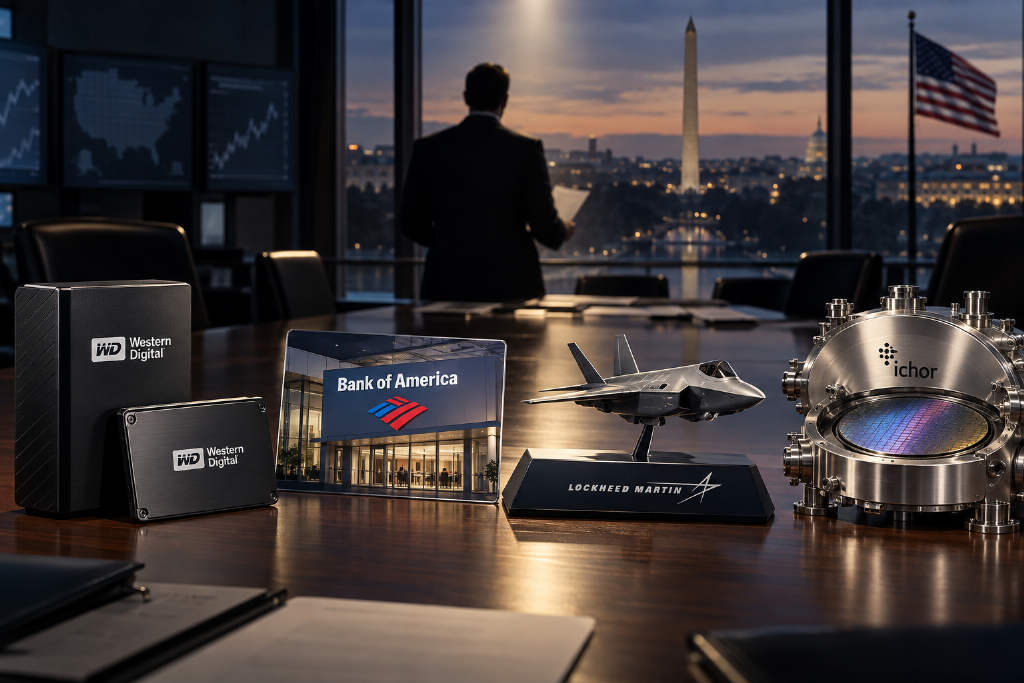
Seeking Alpha2026-09-28 10:00:58Seeking Alpha Quant Flags WDC, BAC, LMT and ICHR as Strong Buys After September PullbackSeeking Alpha Quant strategist Steven Cress said September weakness has created discounts in a group of stocks whose fundamentals have not broken down. In his latest screen, he looked for names rated Quant Strong Buy, trading below their 50-day moving averages, and off recent highs. The four stocks that made the cut were Western Digital, Bank of America, Lockheed Martin, and Ichor Holdings. Cress argued that September is historically one of the weakest stretches of the year, with average declines of more than 1% over nearly a century, and that midterm election years often see lows near Sept. 30. He also pointed to historical data showing that, since 1950, October and November have been the two best-performing months in midterm years, with average gains of 3.0% and 2.7%. The report highlighted different drivers for each stock: AI-linked storage demand and improving valuation for Western Digital; earnings, lending growth, and buybacks at Bank of America; a record backlog and dividend support at Lockheed Martin; and strong growth and valuation metrics at Ichor Holdings, despite weaker profitability scores.220
Treasury yiel2026-09-27 14:55:15Stocks Hold Firm as Treasury Yields Near 20-Year Highs, With AI Seen as SupportU.S. equities are showing resilience even as the 10-year Treasury yield rises to its highest level in nearly two decades, leaving the S&P 500 without a clear hit and prompting investors to revisit how stocks have behaved during past yield surges. The historical record in the report is mixed rather than one-directional. In 1994, a Federal Reserve rate-hike cycle triggered a bond selloff and the S&P 500 fell about 8% before recovering as the economy and corporate earnings stayed firm. In 2016, higher yields were treated as a sign of economic recovery and policy normalization, allowing stocks and Treasury yields to climb together. By contrast, aggressive Fed tightening in 2022 put pressure on both bonds and equities, and the S&P 500 dropped sharply. For 2026, the report says the market is again facing a combination of rising yields and resilient growth. Heavy investment by technology companies in AI infrastructure is described as a support for the economy and stocks, while a U.S.-Iran agreement and lower oil prices could ease inflation pressure. Bank of America rate strategist Meghan Swiber said strong performance in stocks and other risk assets has yet to send the Fed a clear signal that demand is slowing.250
Bank of Ameri2026-09-21 15:53:49BofA credit traders face pressure from conservative AI approachTechub News, citing Crypto Briefing, reported that credit traders at Bank of America are coming under pressure because of the bank’s conservative approach to artificial intelligence. The strategy is described as one that helps guard against untested risks, which gives it a clear risk-control rationale. At the same time, the report says that caution may come at a commercial cost. If rivals adopt bolder AI strategies, Bank of America could lose market share and miss potential revenue growth opportunities in credit trading. The report does not provide additional figures or a timeline beyond the current pressure on traders, but it frames the issue as a trade-off between limiting risk and keeping pace with more aggressive competitors.300